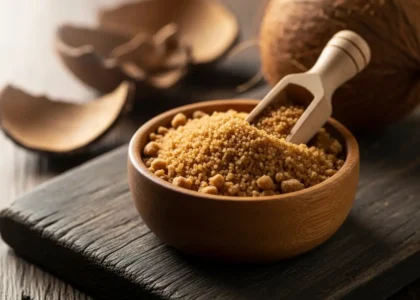
Coconut sugar contains roughly the same calories and carbohydrates as regular table sugar, but it also retains small amounts of minerals, antioxidants, and plant compounds from coconut palm sap. While it is often marketed as a healthier sweetener, its nutritional advantages are modest. Understanding the complete nutrition facts helps you decide when coconut sugar fits into a balanced diet—and when it doesn’t.
Unlike many articles that simply compare calories, this guide explains what actually remains after processing coconut sap, how much nutrition survives, and whether those nutrients make a meaningful difference in everyday consumption.
Coconut sugar is produced by collecting sap from the flower buds of the coconut palm (Cocos nucifera). The fresh sap is gently heated to evaporate water until natural sugar crystals form.
Because the process involves minimal refining, coconut sugar retains traces of compounds naturally present in the sap. This is one reason it differs slightly from highly refined white sugar, which contains almost pure sucrose.
However, “less processed” should not automatically be interpreted as “highly nutritious.” Coconut sugar remains a form of added sugar and should still be consumed in moderation.
The exact values vary by manufacturer, harvest season, and moisture content. However, most products provide similar nutritional profiles.
| Nutrient | Approximate Amount |
|---|---|
| Calories | 375–390 kcal |
| Carbohydrates | 92–96 g |
| Total Sugars | 90–93 g |
| Protein | Less than 1 g |
| Fat | Less than 1 g |
| Fiber | 0–2 g |
| Sodium | 20–40 mg |
| Potassium | 800–1,000 mg |
| Calcium | 50–90 mg |
| Iron | 1–3 mg |
| Magnesium | 20–35 mg |
| Zinc | Trace amounts |
Although these mineral values appear impressive on paper, remember that few people consume coconut sugar in 100-gram portions. A typical serving is only one teaspoon.
A single teaspoon generally contains:
At this serving size, the mineral contribution to daily nutrition is relatively small.
Interested in sourcing premium Indonesian organic coconut sugar? Tropical Coco Indonesia provides reliable export-quality coconut sugar for businesses worldwide.
See also: Coconut Sugar Side Effects You Must Know Before Making the Switch
One feature that separates coconut sugar from refined white sugar is the presence of naturally occurring micronutrients.
Potassium supports muscle function, fluid balance, and healthy nerve signaling.
Although coconut sugar contains measurable potassium, the amount in a teaspoon is only a tiny fraction of the recommended daily intake.
Magnesium plays a role in energy production, muscle contraction, and hundreds of enzyme reactions throughout the body.
Again, the serving size limits its overall nutritional impact.
Iron contributes to oxygen transport in the blood.
Coconut sugar contains slightly more iron than refined sugar, but it should never be considered a primary dietary source.
Small amounts of calcium remain after processing the coconut sap.
The quantity is far below what dairy products, leafy vegetables, or fortified foods provide.
Yes, coconut sugar naturally contains small quantities of antioxidant compounds.
Researchers have identified several naturally occurring polyphenols that originate from coconut sap. Some products also retain traces of flavonoids and phenolic compounds after processing.
Another interesting component is inulin, a naturally occurring prebiotic fiber.
Inulin may help slow sugar absorption slightly while supporting beneficial gut bacteria. However, the concentration varies significantly between manufacturers because heating conditions influence how much remains after production.
This variation is one reason different coconut sugar brands may not offer identical nutritional benefits.
One of coconut sugar’s most discussed characteristics is its glycemic index (GI).
Some studies report GI values around 35–54, while regular table sugar generally falls between 60 and 65 depending on testing methods.
Several factors explain why published numbers differ:
Because of these variables, consumers should avoid assuming that every coconut sugar product has the same glycemic response.
More importantly, glycemic index does not change the fact that coconut sugar is still rich in carbohydrates and added sugars.
| Nutrition Factor | Coconut Sugar | White Sugar |
|---|---|---|
| Calories | Nearly identical | Nearly identical |
| Carbohydrates | Nearly identical | Nearly identical |
| Processing | Minimal | Highly refined |
| Minerals | Small amounts | Almost none |
| Antioxidants | Present in traces | Virtually absent |
| Inulin | Sometimes present | None |
From a nutritional standpoint, coconut sugar offers slightly more than white sugar—but not enough to classify it as a nutrient-dense food.
The answer depends on what “healthier” means.
If you’re comparing ingredient quality, coconut sugar has several advantages:
However, if you’re evaluating calories or sugar intake, the difference becomes much smaller.
Replacing white sugar with coconut sugar without reducing overall sugar consumption is unlikely to produce significant health improvements.
For people managing diabetes, insulin resistance, or metabolic conditions, coconut sugar should still be counted as added sugar unless advised otherwise by a healthcare professional.
International health organizations generally recommend limiting added sugar intake rather than focusing on one specific sweetener.
A practical approach is to use coconut sugar:
The key benefit comes from replacing highly refined sugar occasionally—not from consuming larger amounts because it appears more natural.
Several marketing claims have exaggerated coconut sugar’s nutritional value.
No.
Although it contains beneficial compounds, the serving size is too small for coconut sugar to function as a significant nutrient source.
No.
Coconut sugar still raises blood glucose and should be consumed carefully.
Not exactly.
Most vitamins are present only in trace amounts, while minerals remain relatively modest per serving.
Natural production does not automatically make a food healthier.
Overall dietary patterns matter much more than choosing one sweetener over another.
Coconut sugar provides nearly the same calories and carbohydrates as regular sugar but retains small amounts of potassium, magnesium, calcium, iron, antioxidants, and prebiotic inulin because it undergoes less refining. These nutritional differences are real but relatively modest at normal serving sizes.
Rather than viewing coconut sugar as a health food, it is more accurate to consider it a minimally processed sweetener with a distinctive caramel flavor and slightly richer nutritional profile. Used in moderation as part of a balanced diet, it can be a reasonable alternative to refined sugar—but it is not a substitute for nutrient-rich whole foods.